Gold in skincare sounds like the ultimate luxury, and it has a long history in beauty rituals. But what does a little gold in a cream actually do for your skin, and what is mostly marketing?
This guide sorts the known facts from the sales talk. It also shows how our Mineral Gold line of cleansers, day creams, night creams and eye creams fits a simple routine, based on what each product is made to do.
Key takeaways
- Gold is very stable and rarely reacts with anything, which is why it doesn’t tarnish.
- Research on gold in skincare is limited, so claims that gold lifts, repairs or boosts collagen lack good support.
- Gold can cause allergic reactions in a small number of people, so patch test any gold product.
- In most gold products, the other ingredients do the main work: moisturizers, antioxidants and acids.
- Choose a Mineral Gold product by its main ingredient, such as green tea, collagen, pomegranate, vitamin C or olive oil.
Why gold shows up in skincare
Gold has signaled wealth and beauty for thousands of years. Today, spas still offer gold leaf facials, and gold on a label instantly suggests something special. That appeal is the main reason brands use it.
In products, gold usually appears in one of three forms:
- Gold leaf or flakes: thin pieces you can see, mostly there for the look and feel of luxury.
- Colloidal gold: tiny gold particles spread through a liquid or gel.
- Gold-colored minerals: mica and similar pigments add a golden shimmer, but they contain no gold at all.
The label alone rarely tells you how much gold a product contains, or in what form. So it helps to read the full ingredient list.
What the science says about gold in skincare
Gold is chemically stable. It doesn’t rust or tarnish, and it rarely reacts with other substances. That is great for jewelry, but it also means gold does very little chemistry on your skin.
Some laboratory studies have tested gold particles for antioxidant or soothing effects. However, results in a lab dish don’t automatically carry over to a cream on human skin. Good studies of gold creams on real people are scarce, and cosmetic products usually contain only small amounts.
So treat promises that gold will lift, repair or rebuild your skin with healthy doubt. The more useful question is simple: what else is in the formula?
Gold in skincare claims: fact or marketing?
Here are the claims you will see most often, with what is actually known about each one.
- “Gold gives skin a glow.” Partly true. Visible gold or mica reflects light, so skin can look brighter right away, although the effect washes off.
- “Gold lifts and firms.” Not well supported. A firmer feel usually comes from moisturizers and film-forming ingredients instead.
- “Gold boosts collagen.” Not shown in people. Sunscreen, retinoids and vitamin C have much better support for that job.
- “Gold calms redness.” Mostly lab data. Gentle formulas and soothing ingredients matter more.
- “Gold suits every skin.” Not always, because some people are allergic to it.
Can gold irritate your skin?
For a small number of people, gold is a contact allergen. If gold earrings or rings have caused a rash before, a gold cream may do the same. People who react to nickel sometimes react to gold as well.
An allergic reaction usually shows up as an itchy, red rash where the product touched your skin, and it can appear a day or two later. The American Academy of Dermatology explains how contact dermatitis develops and when to see a dermatologist.
The safest habit is a patch test. The AAD suggests applying a new product to your inner forearm twice a day for four to five days before you use it on your face. Its tips on getting results from anti-aging products walk you through it.
How the Mineral Gold line fits your skincare
Our Mineral Gold line comes in five versions: Green Tea, Collagen, Pomegranate, Vitamin C and Holyland Jerusalem olive oil. Each version offers some or all of these steps: a cleanser, a day cream, a night cream and an eye cream.
Here is the honest part. The product descriptions focus on the green tea, collagen, pomegranate, vitamin C or olive oil in each formula, not on gold. They also don’t state how much gold each product contains. So choose by the main ingredient and your skin’s needs, rather than by the word gold.
| Version | Cleanser | Day cream | Night cream | Eye cream | Focus in the description |
|---|---|---|---|---|---|
| Green Tea | Yes | Yes | Yes | Yes | Antioxidants and light, all-day moisture |
| Collagen | Yes | No | Yes | Yes | Elasticity and a plumper look of fine lines |
| Pomegranate | Yes | Yes | Yes | Yes | Antioxidants, vitamin E and smooth, supple skin |
| Vitamin C | No | Yes | Yes | Yes | Antioxidant care and a brighter, more even look |
| Holyland Jerusalem olive oil | Yes | Yes | No | Yes | Olive oil for soft, moisturized skin that doesn’t clog pores |
The table reflects the Mineral Gold products in our store at the time of writing. You can browse the day creams in our day care collection.
A simple skincare routine with Mineral Gold products
The product directions for this line follow the same pattern. Here they are as one easy routine.
- In the morning, massage a small amount of Mineral Gold cleanser over your face in circles, avoiding the eyes and mouth, then rinse.
- Next, apply your day cream while your face is still slightly damp, since creams lock in moisture better on damp skin.
- Then tap a Mineral Gold eye cream around the eyes in small dots with your ring finger.
- Finish with sunscreen, SPF 30 or higher, because the day creams don’t list sun protection.
- At night, cleanse again and pat your face dry.
- After that, apply the night cream with gentle upward strokes, and carry it down to your neck.
- Finally, add your eye cream again, keeping it away from the lash line.
You can also mix versions. For example, a vitamin C day cream pairs well with a collagen night cream. Our guides to using vitamin C morning and night and to what topical collagen can do explain each ingredient in more depth.
Products that fit this routine
These products cover each step, plus one weekly mask that does list real gold. If you are pregnant or breastfeeding, ask your doctor before using the mask, because it contains lactic acid.
- Green Tea & Mineral Gold Daily Cleanser: an antioxidant-rich cleanser that removes dirt from pores without stripping all of your skin’s natural oil.
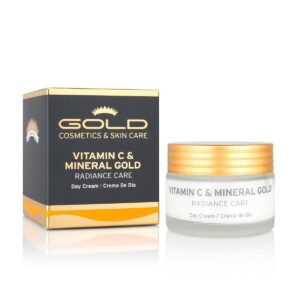
- Vitamin C & Mineral Gold Day Cream: a vitamin C day cream for antioxidant care that helps the look of brown spots and uneven tone.
- Collagen & Mineral Gold Night Cream: a collagen night cream that plumps the surface so fine lines look less noticeable, applied to face and neck.
- Pomegranate & Mineral Gold Day Eye Cream: a pomegranate eye cream for the delicate eye zone that helps the look of puffiness and dark circles.
- Shir Gold Mask: a lifting mask with 24 KT gold and lactic acid, left on face and neck for 5 to 10 minutes, once or twice a week.
- Sun Block SPF 50 Regular: an oil-free, lightweight sunscreen with UVA and UVB protection, water-resistant for up to 80 minutes.
In the Shir Gold Mask, lactic acid is the ingredient with the better-known role. It is a gentle exfoliating acid that helps smooth the surface of the skin.
Common mistakes
- Buying a product for the word gold rather than for its actual ingredients.
- Skipping sunscreen because a day cream feels rich and protective.
- Ignoring a rash from a gold product, especially if gold jewelry has bothered you before.
- Expecting a gold mask to lift skin the way a clinic treatment does.
- Using an acid mask more often than the directions say, which can irritate your skin.
Frequently asked questions
Does gold in skincare actually work?
It depends on what you expect. Visible gold or gold-colored minerals can give a short-lived glow. However, there is little good evidence that gold itself lifts, firms or rebuilds skin. In most gold products, the moisturizers, antioxidants and acids do the real work, so judge the whole formula rather than the gold.
Is 24K gold better than other gold in creams?
24K simply means pure gold, as opposed to an alloy mixed with other metals. In jewelry, purity matters for color and softness. On skin, there is no good evidence that 24K gold works better than other forms. The amount, the other ingredients and how well your skin tolerates the product matter far more.
Can I be allergic to gold skincare?
Yes, although it is uncommon. Gold can cause allergic contact dermatitis, an itchy, red rash where the product touched your skin. If gold earrings or rings have bothered your skin before, be extra careful. Patch test on your inner forearm for several days, and stop using the product if a rash appears.
Which Mineral Gold version should I choose?
Choose by your main concern. The green tea and pomegranate versions focus on antioxidants and moisture. The collagen version focuses on elasticity and a plumper look. Vitamin C suits uneven tone and brown spots, while the olive oil version focuses on soft, moisturized skin. You can also mix versions between morning and night.
Do I still need sunscreen with a gold day cream?
Yes. The Mineral Gold day creams don’t list sun protection, so they can’t replace sunscreen. Apply a sunscreen with SPF 30 or higher as the last step of your morning routine, on your face, neck and any exposed skin. Sunscreen protects your skin far more than any gold ingredient can.
Gold in skincare can be a pleasant extra, but your results come from the basics: gentle cleansing, moisture, the right actives and daily sunscreen. Browse our night care collection to compare the Mineral Gold night creams. Not sure which products fit your skin? Send us a message and we will help you choose.